
USA vs Europe vs China: The AI Models and Tools Compared
Which AI companies, models, and tools come from the United States, Europe, and China, how they differ on capability, price, open weights, and deployment, and how to choose between specific products rather than countries.
A developer in Berlin building a contract-review tool can now choose between a closed model from San Francisco, a downloadable trillion-parameter model from Paris, and an MIT-licensed model from Hangzhou that costs a fraction of either per token. All three can be running on servers in Frankfurt by the afternoon. The country a model comes from still matters, but less directly than most headlines suggest.
This guide maps the AI ecosystems of the United States, Europe, and China as they stand at the end of October 2026: who builds what, which models are open or closed, what they cost, and where each one can actually run. It then turns that map into practical choices by task. Prices and model versions change monthly, so every figure here carries a date and a link to a page we keep updated.

Why these three regions, and where the familiar story breaks down
The usual shorthand goes like this: America invents, Europe regulates, China copies cheaply. Each part contains a grain of truth and each part misleads.
Start with capability. Stanford HAI’s 2026 AI Index reports that US and Chinese models have traded the lead several times since early 2025, and that as of March 2026 the top US model led the best Chinese model by about 2.7%. The US still produces more top-tier models and higher-impact patents. China leads on publication volume, citations, and total patent output. That is not a picture of one side copying the other.
Money tells a different story. The same report puts US private AI investment in 2025 at $285.9 billion, more than 23 times China’s $12.4 billion, with Europe at about $20.9 billion. Stanford notes that China’s private figure likely understates total spending because of government guidance funds. Even so, the gap helps explain why US labs dominate closed frontier models and consumer reach, while Chinese labs compete hard on efficiency and open weights.
Europe is not only a regulator either. Mistral trained a trillion-parameter model in its own data centers and released the weights. Black Forest Labs in Germany builds the widely used FLUX image models. DeepL is a standard translation tool in many companies. What Europe lacks, so far, is a closed frontier lab at the scale of OpenAI, Anthropic, or Google, and a consumer assistant with comparable reach.
The rest of this guide looks at specific products, because that is where the useful differences are.
What counts as American, European, or Chinese AI
Grouping companies by country is less tidy than it sounds. Three distinctions matter.
Europe is not the European Union. France and Germany are EU members, so Mistral AI and Black Forest Labs fall under EU law at home. The United Kingdom and Switzerland are in Europe but outside the EU. Stability AI is a UK company, so calling it an “EU company” is wrong, even though it must follow the EU AI Act when it sells into the EU.
Ownership changes. Aleph Alpha, the Heidelberg lab once pitched as Germany’s sovereign AI champion, agreed in 2026 to be acquired by Canada’s Cohere. Reports say the definitive agreement was signed in September 2026; we have not found confirmation that the deal has closed. Hugging Face, the main hub for open models, was founded by French entrepreneurs and is headquartered in New York.
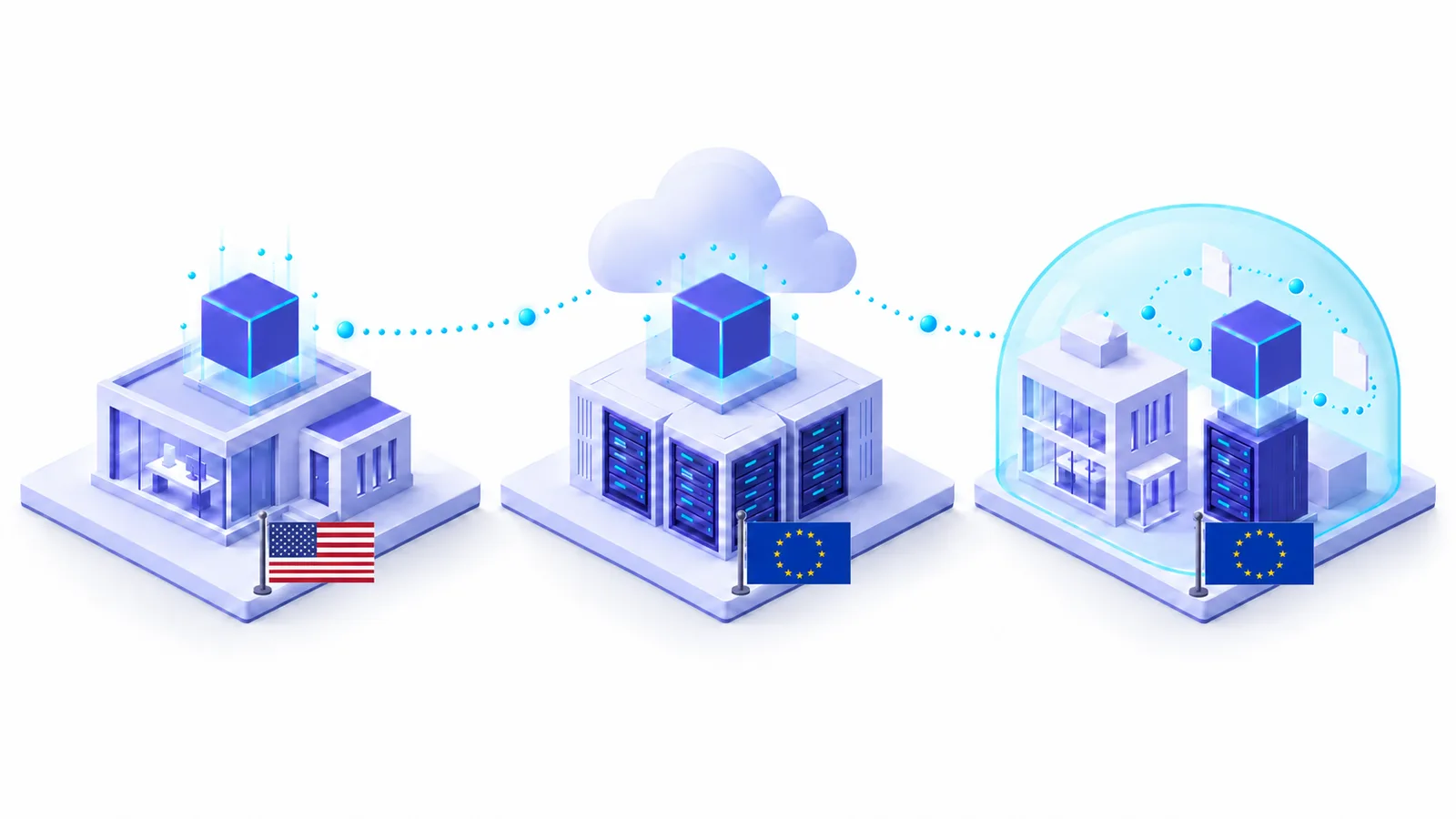
Origin is not deployment. A model’s country of origin tells you who trained it. It does not tell you:
- where your data is processed, which depends on the endpoint or server you use
- which law governs your contract, which depends on who you buy from
- which chips it was trained on (Mistral Large 4 was trained on NVIDIA hardware in European data centers)
- what the license allows
A US model can run in an EU cloud region. A Chinese open-weight model can be served by a European hosting company with no traffic going to China. A European model can run on Microsoft’s Azure. Geography is one input to a privacy or security decision, not the answer.
| Company | Headquarters | EU member? | Best known for |
|---|---|---|---|
| OpenAI, Anthropic, Google, Meta, xAI, Microsoft | United States | No | Closed frontier models, assistants, coding agents |
| Mistral AI | France | Yes | Large open-weight models, the Vibe assistant |
| Black Forest Labs | Germany | Yes | FLUX image and video models |
| DeepL | Germany | Yes | Translation and writing |
| Aleph Alpha | Germany | Yes | Enterprise AI platform (acquisition by Cohere announced) |
| Stability AI | United Kingdom | No | Stable Diffusion and Stable Audio |
| DeepSeek, Alibaba (Qwen), Moonshot AI (Kimi), Z.ai (GLM), MiniMax, ByteDance, Kuaishou | China | No | Low-cost and open-weight models, video generation |
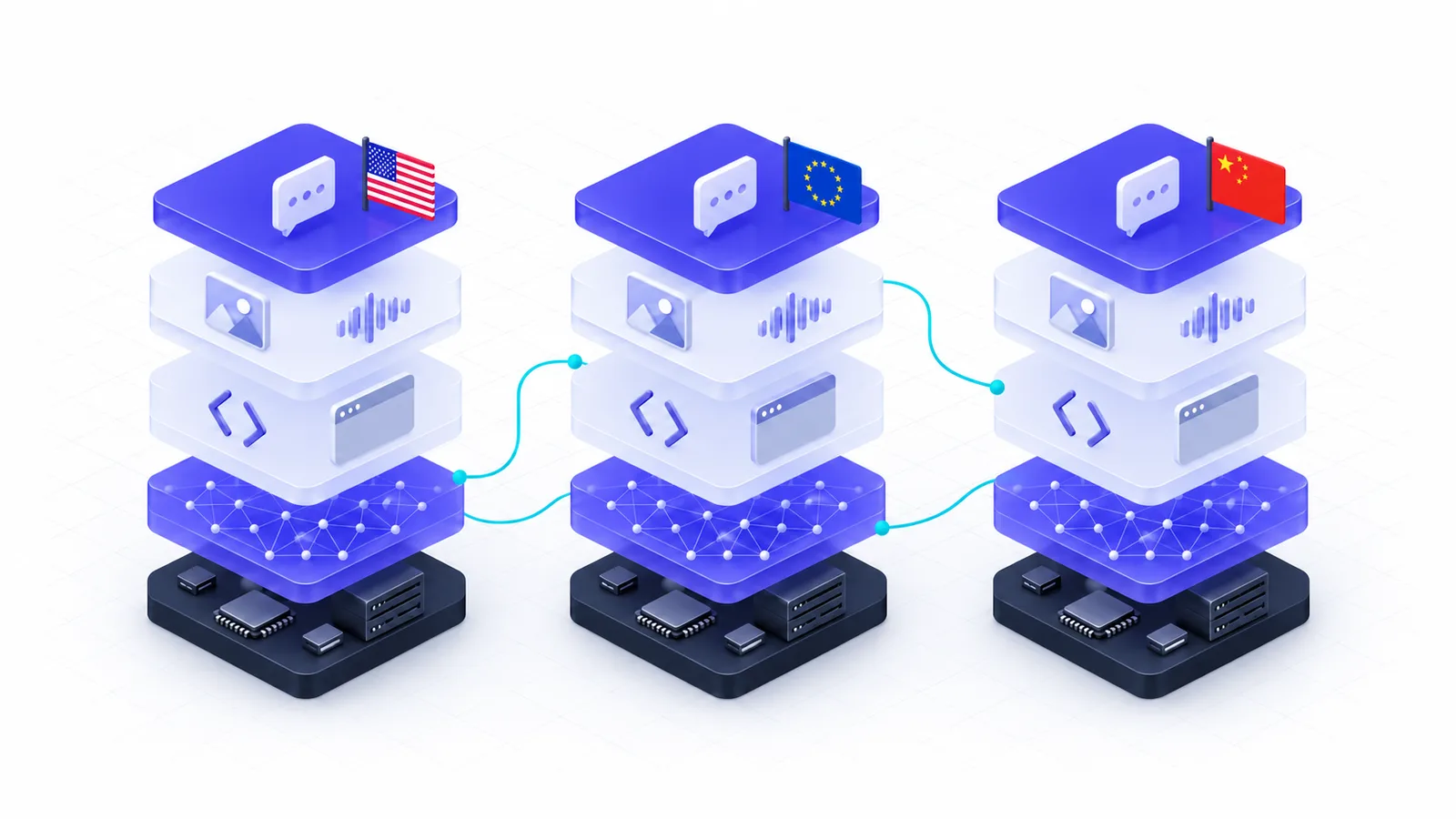
The US ecosystem: closed frontier models and large product platforms
US companies make most of the AI products people use daily, and they hold the top scores on the Artificial Analysis Intelligence Index, an independent benchmark suite (we track version 4.3.2 across our comparison pages).
OpenAI runs ChatGPT on the GPT-6 family. GPT-6 Astra is the frontier model ($10 / $50 per million input/output tokens). GPT-6.1 Sol, released September 29, is the value workhorse at $2 / $10 and powers ChatGPT Work and Codex, OpenAI’s coding agent. Dots are always-on agents with their own cloud computer. ChatGPT Images 2.6, released November 4, handles image generation, editing, and short animated GIFs inside ChatGPT, with GPT Image 2.6 models in the API.
Anthropic builds Claude. Fable 5.2 (released November 9, 2026) is its most capable broadly available model ($8 / $40), Opus 5.5 ($4 / $20) is the workhorse for long agentic tasks, and Sonnet 5.5 and Haiku 5.5 are cheaper tiers. Opus 5.5 scored 58 on the v4.3.2 index used in this guide, the highest among the models in our table; Fable 5.2 arrived after that version and scores 65 on v5.0.1, which is not directly comparable. Claude Code runs in the terminal, IDEs, a desktop app, and the browser, and Claude Duet is a proactive agent in research preview. Claude has no native image generation.
Google offers Gemini. The Gemini 4 family runs from Carbon, the strongest, through Argon and the mid-tier Neon (released November 18, $3 / $15 on the API) down to Hydrogen, the fast everyday model and the only one on the free API tier. Carbon and Argon cost $2 / $10 through November 30, 2026, then $4 / $20. Gemini Tasks became free in November, but only in the US, Japan, South Korea, Canada, Australia, and India; it is not offered at all in the EEA, UK, or Switzerland. Google also has Veo for video, the Gemini Notebook research tool (formerly NotebookLM), deep Workspace integration, and Genie 4, an interactive world model now in Project Genie for Google AI Ultra subscribers and on the paid API.
Meta has split into two tracks. The consumer side is Meta AI inside WhatsApp and Instagram and Meta Muse, a personal agent on its own cloud machine. The developer side includes the closed Muse Wonder model ($4 / $20), the Muse Code agent, and open-weight releases: Muse Spark Open (816B parameters) and the much smaller Muse Glimmer (30B, Apache 2.0).
xAI’s Grok 4.7 is priced at $2 / $6 with a 500K context window and has a free tier. Microsoft matters less for its own models than as a distributor: Copilot for consumers and Microsoft 365, and Microsoft Foundry, which hosts models from OpenAI, Mistral, and others with private Azure deployment options.
The pattern: US labs lead on closed frontier capability and on finished products with agents, connectors, and enterprise contracts. Their open-weight releases exist (Meta’s especially) but are not their main business.
The European ecosystem: open weights, creative models, and enterprise control
Europe’s AI industry is smaller, but it has clear specialties.
Mistral AI (France)
Mistral is Europe’s leading model lab. Mistral Large 4 is a roughly 1-trillion-parameter Mixture-of-Experts model with a 1M-token context window and text and image input. Its weights went up on Hugging Face on October 29, 2026, under the Mistral Ecosystem Open-Weight License: a modified MIT license that allows commercial use but requires a separate license for companies selling hosted access to the model. API pricing is $0.70 / $2.10 per million tokens. Mistral reports 48% on the Artificial Analysis Coding Agent Index, about tied with China’s GLM-5.3 while using 47% fewer tokens per task.
Below it sits Mistral Medium 3.5, a 128B dense model with open weights under a modified MIT license, a 256K context, and API pricing of $1.50 / $7.50. Mistral says it can be self-hosted on as few as four GPUs and reports 77.6% on SWE-Bench Verified. Mistral Small 4 covers lighter workloads. Voxtral 3, released in preview on October 20, is a speech family for transcription and voice agents; unlike earlier Voxtral releases, its weights are not published.
On the product side, Mistral renamed its Le Chat assistant Vibe in 2026. Vibe combines a work assistant (research, documents, connectors, scheduled tasks) with a coding agent that runs in the terminal, VS Code, JetBrains, and Zed. Enterprise customers can deploy it on-premises, in a private cloud, or on Mistral’s cloud with data residency.
Black Forest Labs (Germany)
Black Forest Labs makes the FLUX models. Its FLUX.2 image family, released in late 2025, is widely used through its API and partner platforms, with some smaller variants available as open weights under licenses that differ by model. FLUX 3, announced in July 2026, is a single multimodal model covering image, video, and optional audio. Its site now lists FLUX 3 Image, FLUX 3 Video, an open-weight FLUX 3 Image Klein model, and FLUX 3 Action. Licensing varies by model, with separate non-commercial and commercial terms, so check the specific model card.
One detail shows how tangled origin can be: FLUX 3 Max, a fast video model, was post-trained by US-based fal on Black Forest Labs’ FLUX 3 base.
DeepL (Germany)
DeepL started as a translation service and has grown into writing assistance (DeepL Write) and an enterprise agent, DeepL Agent, which became generally available in late 2025. It is a narrow tool compared with a general assistant, and that focus is the point: it is built for professional translation workflows, glossaries, and document formats.
Stability AI (United Kingdom, outside the EU)
Stability AI, the company behind Stable Diffusion, has shifted toward enterprise and audio. Its Stable Audio 3.0 family launched in May 2026, with three of four models available as open weights; organizations above $1 million in annual recurring revenue need an enterprise license for commercial use.
Aleph Alpha (Germany)
Aleph Alpha moved from building its own frontier models to PhariaAI, a platform for deploying AI on an organization’s own infrastructure, popular with German public-sector and regulated customers. Its pending acquisition by Cohere means it may soon be part of a Canadian-headquartered company with a Berlin base.
What Europe does well: large open-weight models with published licenses, self-hosting and data-residency options, translation and multilingual work, and image generation. Where it is thin: consumer assistants with mass reach, closed frontier models at the top of the independent rankings, and compute at US scale. Mistral trained Large 4 on 3,800 NVIDIA GPUs, which is substantial but small next to the largest US clusters, and depends on US-designed chips.
The Chinese ecosystem: efficient models, open weights, and video
China’s leading labs compete mainly on two fronts: price per token and openly downloadable weights. Several also lead in AI video.
DeepSeek runs DeepSeek V4.1 Flash as its main model: a 552B-parameter MoE model with about 8B to 16B parameters active, a 1M-token context, and weights under the MIT license. API pricing is $0.30 / $1.20 at peak and half that off-peak. It scores 45 on the independent index, the highest of the low-cost models we track. The larger V4-Pro is still available. Reasoning is a per-request thinking mode rather than a separate product.
Alibaba builds the Qwen family. Qwen3.8-Max is a 2.4-trillion-parameter flagship at $2 / $6 through Alibaba Cloud, with text-only open weights under a custom license. Qwen3.8-27B is a dense model under Apache 2.0 designed for a single consumer GPU. Alibaba’s consumer Qwen app is built mainly for Chinese users and ties into Taobao and Alipay; outside China most people use Qwen models through APIs or open weights.
Moonshot AI makes Kimi. Kimi K3.1 Pro, released October 23, shares Kimi K3’s 2.8-trillion-parameter architecture and costs $2 / $10. Artificial Analysis independently measured it at 67.2% on Terminal-Bench 4.0, a demanding agentic coding test, putting it level with the best closed models on that benchmark. Its weights went up on Hugging Face on November 4, 2026, under a custom license with conditions for hosting businesses and very large products, joining Kimi K3’s. Kimi Code is Moonshot’s MIT-licensed terminal coding agent.
Z.ai offers GLM-5.3, a roughly 753B-parameter open-weight coding model with a 1M context, priced at $1.40 / $4.40, and a GLM Coding Plan from $18 a month. Its license is MIT-style, with a security review required only for hosting businesses above $10 billion in revenue.
MiniMax makes MiniMax M3.1 Flash, an open-weight agent model at $0.15 / $0.60, flat across its 1M context. It scores 43 on the index and is one of the cheapest capable models available.
ByteDance runs Seedance for video and Seedream for images, both available through its Dreamina creative platform and its Volcano Engine cloud, plus Doubao, which led Chinese AI apps by monthly users in early 2026, according to figures reported by Caixin. Kuaishou makes Kling AI, a widely used video generator. Baidu (Ernie) and Tencent (Hunyuan) run large assistants and model families too, used mostly inside China. Baidu’s ERNIE 5.5 Flash Base, released as open weights on November 5, 2026, is a base checkpoint for fine-tuning rather than a chat assistant, and its license excludes the EU, the UK, and South Korea.
Two cautions apply. First, not every Chinese model is open: Qwen3.8-Max’s multimodal features are API-only, and “open” Chinese licenses such as Kimi’s still add conditions for hosting businesses and very large products. Second, hosted Chinese services process data under Chinese law and their own terms. Several regulators restricted DeepSeek’s consumer app in 2025, starting with Italy’s data protection authority. The open weights are a different matter: once you download them, the model runs wherever you put it.
Assistants side by side
These are the apps people sign up for. The model underneath matters, but so do the features, plans, and data terms around it.
| Assistant | Developer | Free tier | Agent features | Coding | Data and deployment notes |
|---|---|---|---|---|---|
| ChatGPT | OpenAI (US) | Yes | Dots, ChatGPT Work | Codex | Business and Enterprise plans add admin and data controls |
| Claude | Anthropic (US) | Yes | Claude Duet (US research preview) | Claude Code | Team and Enterprise add admin controls; no image generation |
| Gemini | Google (US) | Yes | Gemini Tasks | Antigravity | Strongest inside Google Workspace |
| Meta Muse | Meta (US) | Limited | Personal agent on a cloud VM | Muse Code (separate) | Asks before sensitive actions |
| Vibe (formerly Le Chat) | Mistral AI (France) | Yes | Work mode, scheduled tasks | Built in | Enterprise on-premises, private cloud, or Mistral cloud with data residency |
| DeepSeek | DeepSeek (China) | Yes, free web chat | Limited in the app | Through API and third-party tools | Hosted service under Chinese jurisdiction; weights can be self-hosted |
| Kimi | Moonshot AI (China) | Yes, with limits | Long-running agent tasks | Kimi Code | Hosted service under Chinese jurisdiction |
Model quality is not the same as app quality. Kimi K3.1 Pro scores close to Claude Opus 5.5 on Terminal-Bench, but Claude’s app has connectors, enterprise controls, and Claude Code around it. For everyday chat in English, the US assistants and Vibe offer the most complete products. For Chinese-language use and Chinese commerce, Doubao and the Qwen app are built for that market.
Frontier and large language models
This table puts representative models from each region together. Scores are from the Artificial Analysis Intelligence Index v4.3.2 where we have them; dashes mean we do not have a comparable figure.
| Model | Developer (region) | Weights | API price per 1M tokens (input / output) | Context | AA Index |
|---|---|---|---|---|---|
| Claude Opus 5.5 | Anthropic (US) | Closed | $4 / $20 | 1M | 58 |
| GPT-6 Astra | OpenAI (US) | Closed | $10 / $50 | ~1M | 53 |
| Gemini 4 Argon | Google (US) | Closed | $2 / $10 to Nov 30, then $4 / $20 | ~1M | 53 |
| GPT-6.1 Sol | OpenAI (US) | Closed | $2 / $10 | 1M | 52 |
| Muse Wonder | Meta (US) | Closed | $4 / $20 | 1M | 52 |
| Kimi K3.1 Pro | Moonshot AI (China) | Open since Nov 4, custom Kimi license | $2 / $10 | 1M | Not in our tracked data |
| DeepSeek V4.1 Flash | DeepSeek (China) | Open, MIT | $0.30 / $1.20 peak | 1M | 45 |
| MiniMax M3.1 Flash | MiniMax (China) | Open, community license | $0.15 / $0.60 | 1M | 43 |
| Qwen3.8-Max | Alibaba (China) | Open (text-only), custom license | $2 / $6 | See vendor | Not in our tracked data |
| GLM-5.3 | Z.ai (China) | Open, MIT-style | $1.40 / $4.40 | 1M | Not in our tracked data |
| Muse Spark Open | Meta (US) | Open, Muse Model License | Set by hosts | 1M | 39 |
| Mistral Large 4 | Mistral AI (France) | Open, Mistral Ecosystem license | $0.70 / $2.10 | 1M | 38 (preview) |
Prices are list prices checked in October 2026. The Mistral Large 4 score is for the October preview; Mistral finished more training before the weights release, so the released model may score higher.
How to read this: US closed models still hold the top of the overall index, and the open models below them cost far less to run. GPT-6.1 Sol finished the index at about $0.72 per task against about $5.98 for Opus 5.5. DeepSeek V4.1 Flash cost about $0.26 per task. On specific agentic coding tests the picture shifts again: Kimi K3.1 Pro’s independent 67.2% on Terminal-Bench 4.0 matches the closed leaders. A single index number is a summary, not a verdict.
Open weights by region
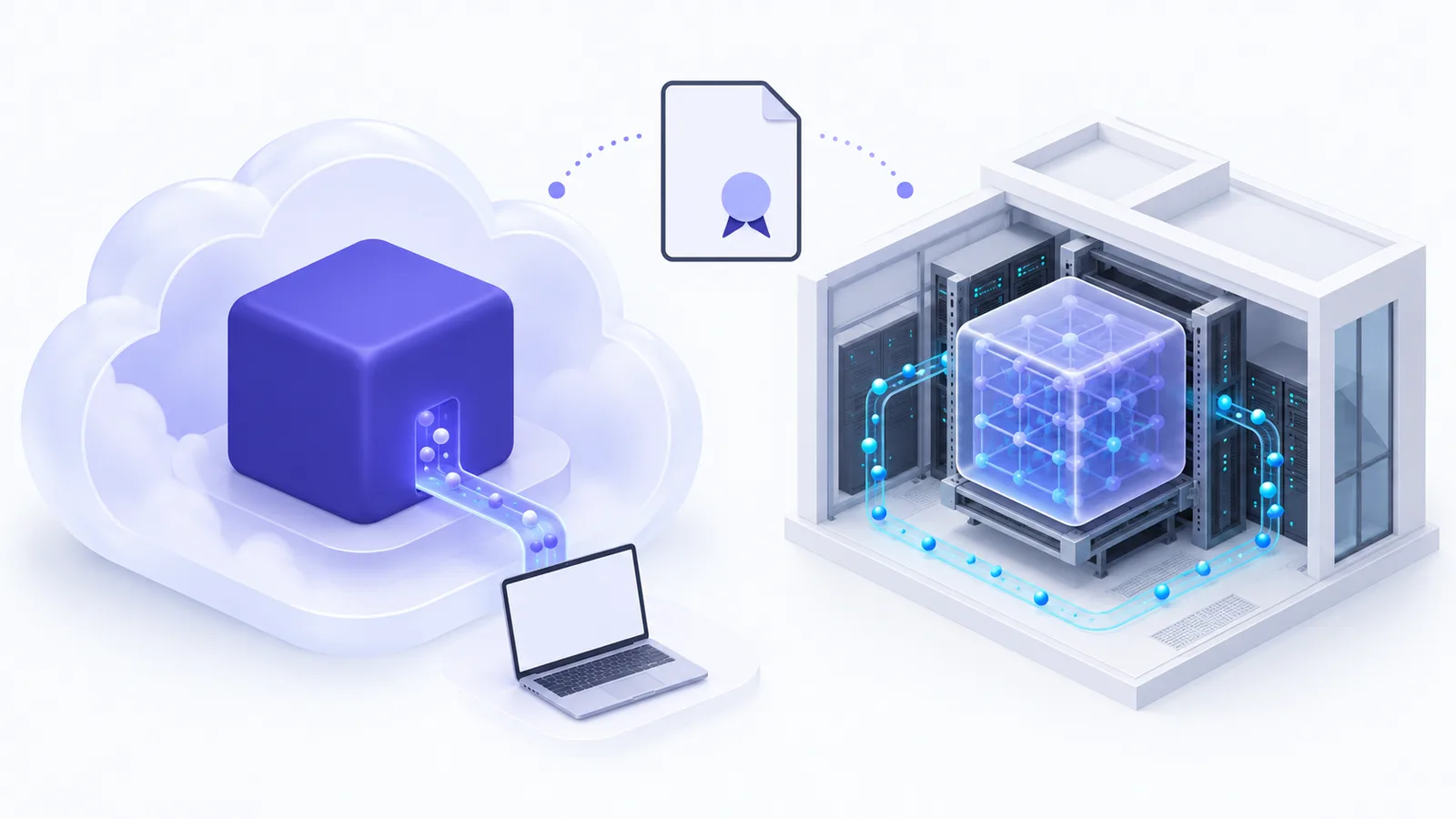
Open weights are where the regions differ most. Chinese labs release the most large open models, Mistral is Europe’s main contributor, and Meta is the main US source.
| Model | Region | License | Commercial use | Hosting-business restriction | Runs on |
|---|---|---|---|---|---|
| DeepSeek V4.1 Flash | China | MIT | Yes | None | Multi-GPU server (~510GB in FP8) |
| GLM-5.3 | China | GLM-5.3 License (MIT-style) | Yes | Security review above $10B revenue | Multi-GPU server |
| MiniMax M3.1 Flash | China | MiniMax Community License | Yes, with attribution (reported) | Written authorization above $20M revenue (reported) | Multi-GPU server |
| Kimi K3 | China | Custom Kimi K3 License | Yes, with conditions at large scale | Separate agreement for large hosting businesses | Large multi-GPU cluster |
| Qwen3.8-Max | China | Custom license | Check terms | Check terms | Large multi-GPU cluster |
| Qwen3.8-27B | China | Apache 2.0 | Yes | None | One high-end consumer GPU |
| Mistral Large 4 | France | Mistral Ecosystem Open-Weight License | Yes | Separate license for any hosting business | Eight data-center GPUs in Mistral’s examples |
| Mistral Medium 3.5 | France | Modified MIT | Yes | Check terms | Four GPUs, per Mistral |
| Muse Spark Open | US | Muse Model License | Yes, with attribution notice | Separate agreement above $20M revenue | Multi-GPU server |
| Muse Glimmer | US | Apache 2.0 | Yes | None | One consumer GPU |
Three points get missed in most coverage.
Open weights are not open source. None of these labs published full training data. Most custom licenses allow broad use but carve out companies that sell hosted access to the model.
Free to download is not free to run. A Mixture-of-Experts model only uses some of its parameters per token, but all of them have to sit in GPU memory. Mistral Large 4 activates about 49B parameters per token and still needs roughly a terabyte of memory at 8-bit precision. Our guide on when local AI makes sense covers the cost side.
Licenses change between versions. Mistral Large 3 used Apache 2.0; Large 4 does not. Black Forest Labs’ small FLUX.2 [klein] 4B was Apache 2.0; FLUX 3 Image Klein is not. Kimi K3.1 Pro ships under its own Kimi K3.1-Pro License rather than Kimi K3’s. Read the license file for the exact version you deploy.
AI coding tools
Coding agents are where the US has the deepest product lineup, but it is not the only option.
| Tool | Developer (region) | Where it runs | Default models | Access |
|---|---|---|---|---|
| Claude Code | Anthropic (US) | Terminal, IDEs, desktop, web | Claude models | Paid Claude plans or API |
| Codex | OpenAI (US) | Terminal, IDE, cloud | GPT-6.1 Sol and others | ChatGPT Plus and above, or API |
| Muse Code | Meta (US) | Terminal | Muse Wonder, Muse Spark | Plans from $5/month or API |
| Mistral Vibe | Mistral AI (France) | Terminal, VS Code, JetBrains, Zed | Mistral Medium 3.5 | Free tier; Pro for all-day coding |
| Kimi Code | Moonshot AI (China) | Terminal | Kimi K3.1 Pro (Plus plan and above) | Free MIT CLI plus paid model access |
| GLM Coding Plan | Z.ai (China) | Works with third-party agents | GLM-5.3 | From $18/month |
| OpenCode | Open source | Terminal, IDE | Any model you connect | Free; bring your own API |
A model-agnostic agent like OpenCode is a practical way to try models from all three regions in the same workflow. For a deeper look at the US tools, see Codex vs Claude Code and Muse Code vs Claude Code.
Image and video generation
Creative AI is spread most evenly across the three regions. Like-for-like comparison matters here: an image model and a video model do different jobs.
Image models
| Model | Developer (region) | Editing | API | Open weights | Notes |
|---|---|---|---|---|---|
| GPT Image 2.6 (ChatGPT Images 2.6) | OpenAI (US) | Multi-turn conversational edits, markup | Yes | No | Ranked #1 and #2 (two variants) in Artificial Analysis text-to-image and editing arenas (Nov 2026); also makes animated GIFs |
| Midjourney V8.2 | Midjourney (US) | Editor, Vary Region | No public API | No | Plans from $10/month; no free tier |
| Muse Image | Meta (US) | Yes | Rolling out to advertisers | No | Free in Meta apps |
| FLUX.2 and FLUX 3 Image | Black Forest Labs (Germany) | Yes | Yes | Some variants, including FLUX 3 Image Klein | Licenses differ by model; Klein’s is free for commercial use only under US$5M revenue |
| Stable Diffusion family | Stability AI (UK) | Yes | Yes | Yes | Enterprise license needed above a revenue threshold |
| Seedream | ByteDance (China) | Yes | Through Volcano Engine and partners | No | Also inside Dreamina |
| Qwen-Image | Alibaba (China) | Yes, strong on text in images | Through Alibaba Cloud | Yes | Check the license of the version you use |
Video models
| Model | Developer (region) | Input | Audio | Clip length | Access |
|---|---|---|---|---|---|
| Veo 3.1 | Google (US) | Text, image | Native | Varies by product | Gemini apps and API |
| Runway Gen-4.5 | Runway (US) | Text, image, video | Varies by tool | Varies | Free tier, plans from about $12 |
| FLUX 3 Max | fal (US), on Black Forest Labs’ FLUX 3 | Text, image | Not on fal’s launch page | 10 s at 720p on fal | Per second on fal and partners |
| FLUX 3 Video | Black Forest Labs (Germany) | Text, image | Optional | Varies | Early access and API |
| Seedance 2.5 | ByteDance (China) | Text, image, audio, video | Native | Up to about 30 s | Dreamina, Volcano Engine, third-party APIs |
| Kling AI 3.0 | Kuaishou (China) | Text, image | Varies by model version | Up to 15 s, multi-shot | Free tier with credits |
Commercial rights depend on the platform and plan you use, not the model alone, so read the terms of the service you generate on. For head-to-head detail, see Seedance vs Veo, Kling AI vs Veo, and FLUX 3 Max vs Seedance.
Ways to deploy, and what each one costs you
Where a model runs often matters more than where it was made. These are the realistic options, with the trade-offs that come with each.
| Approach | Example | Control | Cost profile | Maintenance | Lock-in risk |
|---|---|---|---|---|---|
| Closed API from the model’s maker | Claude, GPT-6.1 Sol, Gemini | Low: the vendor runs everything | Per token; no hardware | Minimal | High: you cannot take the model elsewhere |
| Closed model in a regional cloud | A US model on an EU cloud region | Medium: data stays in-region under contract | Per token, sometimes a premium | Minimal | High |
| Open model through a third-party host | DeepSeek or Mistral weights on a European or US provider | Medium: choose the host and jurisdiction | Per token, competitive | Low | Low: switch hosts freely |
| Self-hosted open weights | Mistral Large 4 or DeepSeek V4.1 Flash on your own GPUs | High: data never leaves your network | High fixed hardware and staff cost | High: serving, scaling, patching | Lowest |
| Managed private deployment | Mistral on Microsoft Foundry or NVIDIA NIM | High, with vendor support | Contract pricing | Shared | Medium |
For many teams the answer is a mix: a closed model for the hardest tasks, an open model for high-volume or sensitive work, and a fallback in case one provider changes terms. That is the reasoning behind using more than one AI model and planning for AI vendor lock-in.
How to compare models without being misled
Quality. Prefer independent evaluations, note the benchmark version and date, and never add together scores from different benchmarks. Vendor launch tables are useful but selective: Moonshot’s own Terminal-Bench figure for Kimi K3.1 Pro (65.7) and Artificial Analysis’s (67.2%) differ, and both are legitimate under different setups. A test on 20 of your own tasks beats any leaderboard.
Price. Look at input price, output price, cached input price, and off-peak discounts separately. DeepSeek halves its rates off-peak; Gemini 4 Argon’s API price doubles on December 1. Then look at cost per completed task, which accounts for how many tokens a model writes and how often it needs a retry. Verbose cheap models can cost more per finished job than their rate card suggests.
Open or closed. Ask four questions: can you download the weights, can you modify them, can you use them commercially, and can you offer them as a service. The answers differ even among “open” models.
Privacy and data control. Check where data is processed, whether a regional endpoint exists, how long prompts are retained, whether they are used for training, and what the contract says. Our guide on AI data retention explains the terms. None of this is decided by the vendor’s nationality alone.
Agents. For agent work, test tool calling, computer use, how the model behaves over long runs, and whether the product supports human approval before risky actions. These depend on the product as much as the model.
Fit with what you already run. A team deep in Microsoft 365, Google Workspace, or a European sovereign cloud will find some options far easier to adopt than others, whatever the benchmarks say.
Regulation and AI sovereignty
AI sovereignty means an organization or country can exercise meaningful control over the AI it depends on: the models, the infrastructure they run on, the data, and the rules governing them. Choosing a local vendor does not guarantee it. A European model running on US-designed chips in a US-owned cloud is only partly sovereign. A Chinese open-weight model running on a company’s own servers can give that company more practical control than a domestic closed API.
United States
The US has no comprehensive federal AI law. An executive order signed in December 2025 set up a Justice Department task force to challenge state AI laws, and a March 2026 White House framework asked Congress to preempt state rules it considers burdensome. Congress has not done so, so state laws such as Colorado’s still apply. The US also restricts exports of advanced AI chips to China, which shapes how Chinese labs train models; see AI export controls. For enterprises, the practical questions are contracts, sector rules (healthcare, finance), and state privacy laws.
European Union
The EU AI Act applies in stages, and the timeline changed in 2026:
- February 2, 2025: bans on prohibited practices and AI literacy duties applied.
- August 2, 2025: obligations for general-purpose AI model providers applied. The Commission’s AI Office gained enforcement powers over them on August 2, 2026.
- August 2026: transparency rules took effect, such as telling people they are talking to a chatbot and labeling deepfakes.
- July 27, 2026: the AI Omnibus amendment entered into force. It adds a new ban on AI-generated non-consensual intimate content and child sexual abuse material from December 2026, and pushes back the high-risk rules.
- December 2, 2027: high-risk rules for uses such as recruitment and credit scoring (Annex III).
- August 2, 2028: high-risk rules for AI built into regulated products such as medical devices (Annex I).
The AI Act applies to anyone placing AI on the EU market, wherever they are based, so US and Chinese providers are covered too. GDPR is a separate law. It governs personal data whatever technology processes it, and it is usually the bigger day-to-day issue for a company sending documents to a model. The Commission’s AI Act Service Desk answers implementation questions.
United Kingdom
The UK is not covered by the EU AI Act at home. It has relied on existing regulators and on the AI Security Institute, which tests frontier models, rather than a cross-sector AI law; a frontier AI bill has been discussed but not enacted. UK GDPR stays close to EU GDPR.
China
Public-facing generative AI services in China must complete a filing with the Cyberspace Administration of China before launch, and more than a thousand services had done so by mid-2026, according to trackers of CAC announcements. Labeling rules for AI-generated content took effect on September 1, 2025, and the CAC has enforced them, including taking apps offline. These rules mainly govern services offered to the public in China. For a company outside China, the relevant question is usually simpler: if you use a Chinese provider’s hosted service, your data goes to that provider under its terms; if you run its open weights yourself, it does not.
A worked example: internal document analysis in Europe
A mid-sized European insurer wants a tool that summarizes claims files containing personal data. Four realistic paths:
- A US closed model through an EU-region endpoint, for example via a major cloud provider. Strong quality and little engineering, with data processed in the EU under a data processing agreement. The insurer depends on a US vendor and must still run a GDPR assessment.
- Mistral’s hosted API with EU data residency. A European contract counterparty and lower token prices, with somewhat lower scores than the top closed models on the independent index. Still needs the same GDPR work.
- Self-hosted Mistral Large 4 or Medium 3.5. Documents never leave the insurer’s network and the model version is pinned. It needs GPU servers and people who can run them. Medium 3.5’s four-GPU footprint makes this far more practical than Large 4.
- Self-hosted DeepSeek V4.1 Flash under MIT. The same control, a permissive license, and a lower compute footprint per token. Some boards will object to a Chinese-origin model on reputational grounds even though no data flows to China; that is a governance decision, not a technical one.
None of these is automatically compliant. Classifying claims handling under the AI Act, documenting the use, testing outputs, and protecting personal data are the insurer’s job whichever model it picks.
Choosing by task, not by flag
Use this as a starting shortlist, then test on your own work.
| If you need | Start by comparing | Why these |
|---|---|---|
| Everyday chat and writing | ChatGPT, Claude, Gemini, Vibe | Complete apps with free tiers; Vibe if you want a European provider |
| The highest overall quality | Claude Fable 5.2 or Opus 5.5, GPT-6 Astra, Gemini 4 Carbon or Argon | Top of the independent index |
| Strong coding agents | Claude Code, Codex, Kimi K3.1 Pro in Kimi Code, GLM-5.3 | Closed leaders plus Chinese models that score close on agentic coding tests |
| Cheap high-volume API work | DeepSeek V4.1 Flash, MiniMax M3.1 Flash, GPT-6.1 Sol | Lowest cost per completed task among capable models |
| Agent execution at scale | GPT-6.1 Sol, DeepSeek V4.1 Flash, MiniMax M3.1 Flash | Low cost per task; route hard steps to a stronger model |
| A model you can self-host on servers | Mistral Large 4, Mistral Medium 3.5, DeepSeek V4.1 Flash, GLM-5.3 | Published weights and licenses; compare hardware needs |
| A model for one GPU | Qwen3.8-27B, Muse Glimmer | Apache 2.0, built for consumer hardware |
| The most permissive license | DeepSeek V4.1 Flash (MIT), Qwen3.8-27B and Muse Glimmer (Apache 2.0) | Fewest conditions on commercial use and hosting |
| EU data residency with vendor support | Mistral (hosted or on-premises), US models on EU cloud regions | Contracts and deployment options, not nationality, provide the guarantee |
| Image generation | GPT Image 2.6, FLUX, Midjourney, Seedream | Top-ranked editing, open variants, distinctive style, ByteDance’s ecosystem |
| Video generation | Veo, Seedance 2.5, Kling 3.0, Runway | Native audio, long clips, free credits, editing tools |
If your priority is a downloadable model that runs inside your own infrastructure, compare the actual weight licenses, hardware requirements, and deployment options of Mistral Large 4, DeepSeek V4.1 Flash, and Qwen before choosing. If your priority is the best result on hard tasks regardless of where the model runs, start with the US closed models and check whether a cheaper model passes your tests. Most organizations end up using models from more than one region, with model routing deciding which handles each job.
Comparisons in this cluster
These pages go deeper on specific cross-region choices:
- USA vs Europe vs China: GPT-6.1 Sol vs Mistral Large 4 vs Kimi K3.1 Pro
- Europe vs China: Kimi K3.1 Pro vs Mistral Large 4, Mistral Large 4 vs GLM-5.3, Mistral Large 4 vs DeepSeek V4.1 Flash
- USA vs Europe: Muse Spark Open vs Mistral Large 4
- USA vs China: Muse Spark Open vs DeepSeek V4.1 Flash, ChatGPT vs DeepSeek, Claude vs DeepSeek, Seedance vs Veo
- Within China: Qwen vs Kimi vs DeepSeek vs GLM, MiniMax M3.1 Flash vs DeepSeek V4.1 Flash
- Within the US: GPT-6.1 Sol vs Claude Opus 5.5, GPT-6 Astra vs Gemini 4 Argon, Claude Opus 5.5 vs Gemini 4 Argon
For background, see open models vs closed models, frontier open models explained, and whether governments should restrict open AI models.
Continue learning
Explore related guides, tools, workflows, and prompts that help you go deeper into this topic.
More practical AI guides for work and business.
Read guideA practical guide to help you understand and apply this topic.
Read guideA practical guide to help you understand and apply this topic.
Read guideA practical guide to help you understand and apply this topic.
Read guideA practical guide to help you understand and apply this topic.
Read guideA practical guide to help you understand and apply this topic.
Read guideMore practical AI guides
Browse guides that show you how to use AI for real work tasks: no hype, just practical steps.
Frequently Asked Questions
Which country has the best AI models?
No single country wins across the board. Stanford's 2026 AI Index found that US and Chinese models have traded the top spot several times since early 2025, with the best US model ahead by about 2.7% in March 2026. On the independent index we track, US closed models such as Claude Opus 5.5 score highest overall, Chinese labs lead on low-cost open-weight models, and Mistral is Europe's main source of large open-weight models. Pick the model that fits your task, budget, and deployment rules rather than its country.
Are Chinese AI models safe to use?
It depends on how you use them. Sending data to a hosted Chinese service means it is processed under that provider's terms and Chinese jurisdiction, which some organizations cannot accept. Downloading open weights, such as DeepSeek V4.1 Flash under the MIT license, and running them on your own servers or a provider you trust keeps prompts and documents off the original developer's systems. You still need to evaluate the model's behavior, security, and license like any other model.
What is the best European AI model?
Mistral Large 4, released with open weights on October 29, 2026, is Europe's largest model and Mistral's flagship. It costs $0.70 per million input tokens and $2.10 per million output through Mistral's API and can be self-hosted on multi-GPU servers. For lighter use, Mistral Medium 3.5 is a 128B model that Mistral says can run on four GPUs. Black Forest Labs (Germany) leads Europe in image and video models, and DeepL in translation.
Is the UK part of European AI regulation?
Not the EU AI Act. The UK left the EU and has its own approach, which so far relies mainly on existing regulators and the AI Security Institute rather than a single cross-sector AI law. UK companies selling AI into the EU still have to meet the EU AI Act for that market. UK GDPR remains close to EU GDPR for personal data.
Does using a European AI provider make my company EU AI Act compliant?
No. The AI Act places duties on providers and deployers based on what a system does and how risky its use is, not on the vendor's nationality. A European model used in a high-risk application still needs the required controls, and a US model accessed through an EU-region endpoint can be part of a compliant setup. GDPR applies separately whenever personal data is involved.
Which open-weight AI models can I run myself?
Small models such as Qwen3.8-27B and Muse Glimmer (both Apache 2.0) are built to run on a single high-end consumer GPU. Large models such as Mistral Large 4, DeepSeek V4.1 Flash, GLM-5.3, Kimi K3, and Muse Spark Open are free to download but need multi-GPU server hardware. Each has its own license, so check commercial and hosting terms before deploying.
Last updated: